My “Art in Architecture” Mosaic Discoveries in Berlin in the Summer of 2026
While I was waiting for the birth of my third grandchild in Berlin, I set out to explore mosaics in the eastern part of the city. I’m familiar with the mosaics at the Haus des Lehrers and the reopened Café Moskau. This summer, I discovered two more wall mosaics at a construction site on Karl-Marx-Allee, just around the corner from my son’s family’s apartment, where I spent a lot of time this summer for the reason mentioned above.
I strike up a conversation with a passerby, who also points out the mosaic fountain in the garden of the former State Council building in Berlin-Mitte. That’s how the idea for a photo walk with my friend and photographer Sabine Ohle was born.
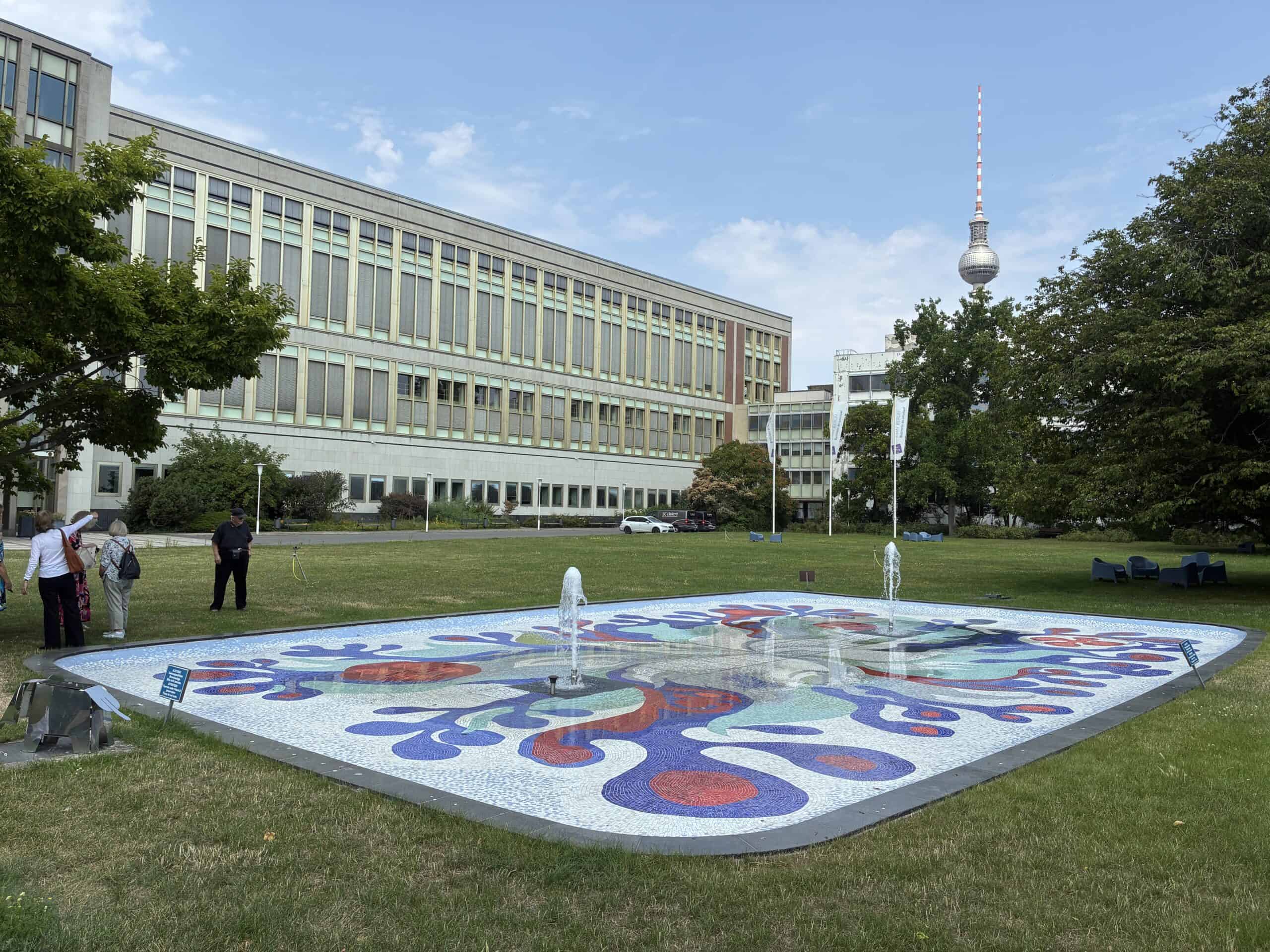
Mosaic fountain in the garden of the former State Council building, now the ESMT (European School of Management and Technology), Schlossplatz 1, 10178 Berlin; Photo: Sabine Ohle
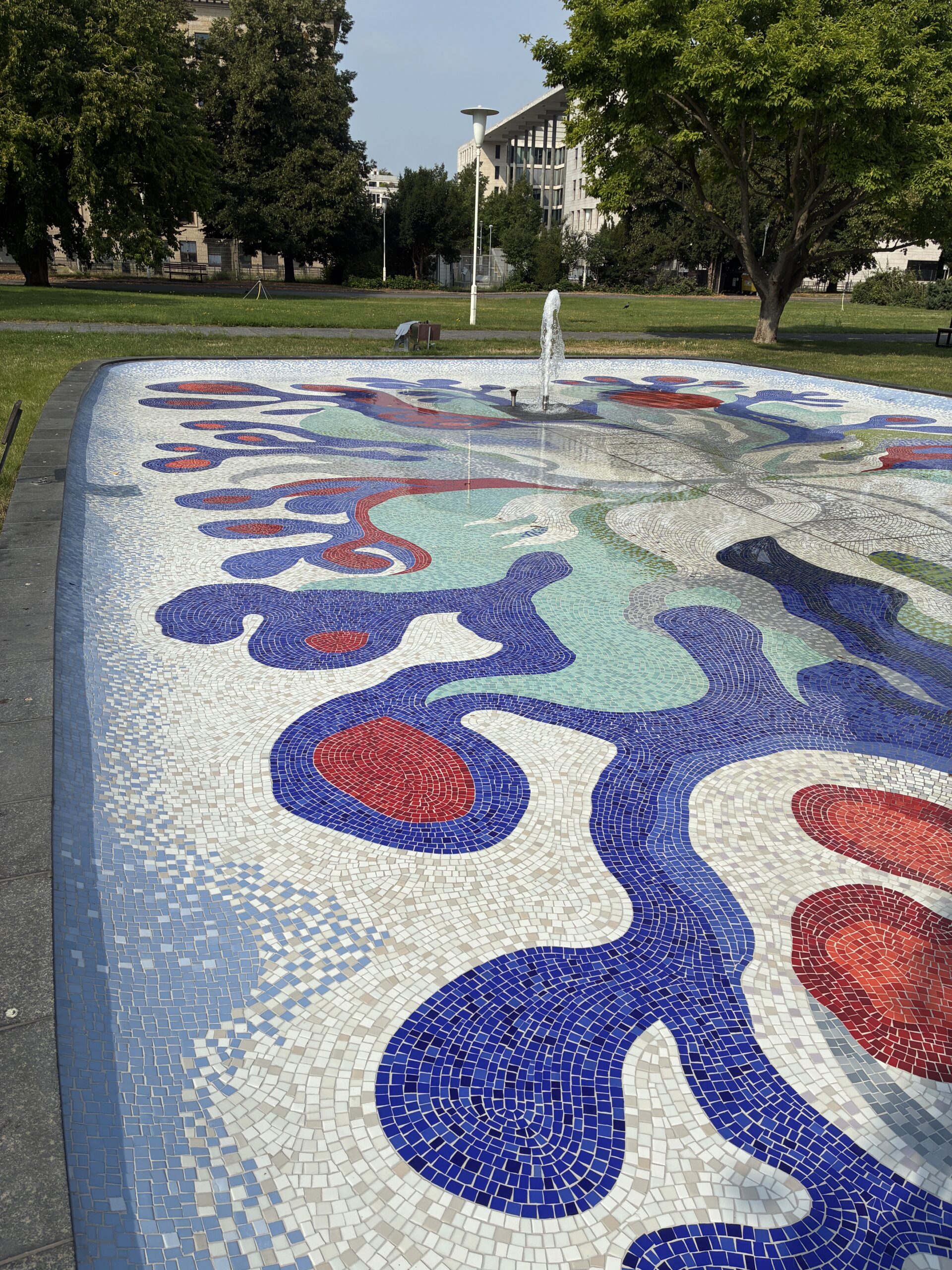
Detail of the mosaic fountain by Ortraud Lerch, 1964, photo by Sabine Ohle
Mosaikbrunnen befindet sich im Garten des ehemaligen Staatsratsgebäudes, heutige ESMT (European School of Management and Technology), Schlossplatz 1, 10178 Berlin
On a hot July morning, I meet up with Sabine to take pictures of the mosaic fountain. The garden is accessible daily through the main entrance of what is now the management school.
On this hot day, we step into an oasis behind the Humboldt Forum—Berlin’s former palace. The grounds, which are deserted during the school break, feature a large lawn, trees, and flower beds, as well as a low-rise building with a café and a ping-pong table.
Aber der Mosaikbrunnen ist der große Farbklecks in diesem eher nüchternen Ensemble. Das Brunnenbecken ist ohne Umrandung flach in den Rasen eingelassen und hebt sich durch seine kräftigen Farben Weiß, Blau und Rot sowie die großen, fließenden Muster wunderbar von seiner Umgebung ab. Er ist ein Hingucker, lädt zum Hineinlaufen ein und ist in dem sonst eher schlicht gehaltenen Garten fast ein störendes Element. Ich bin fasziniert.
The fountain was designed by Ortrud Lerch in 1964. It was restored in 2025 using donations and is now open to the public again.
Here is a brief art-historical description:
https://www.museum-der-1000-orte.de/kunstwerke/kunstwerk/mosaikbrunnen/inline
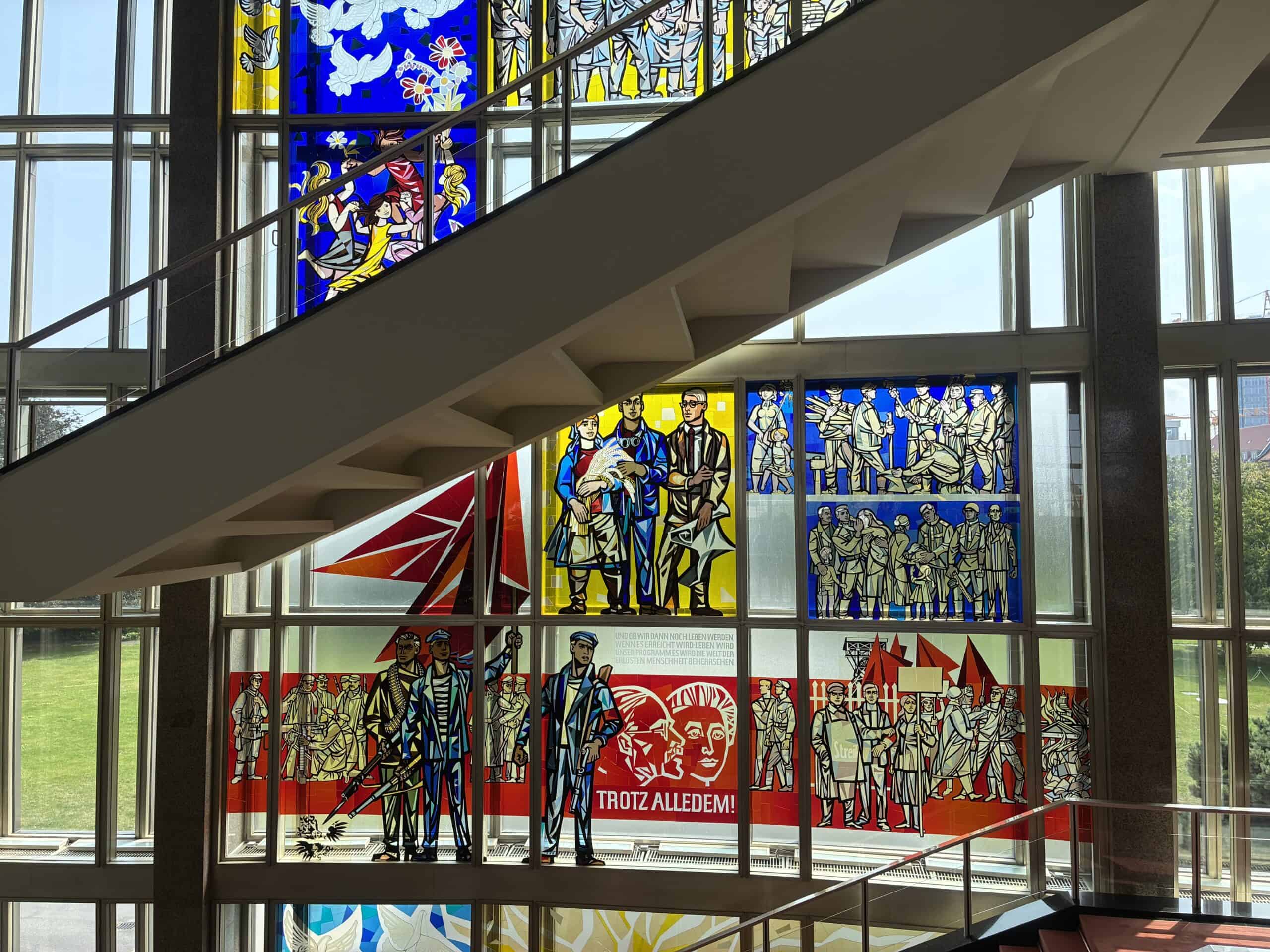
Stained-glass window in the ESMT stairwell, designed by Walter Womacka in 1962, Schlossplatz 1, 10178 Berlin
Sabine and I are in luck: We’re able to join a guided tour of the ESMT building on the spur of the moment. The large, colorful stained-glass window in the stairwell—designed by Walter Womacka in 1962 and spanning three floors—is truly impressive.
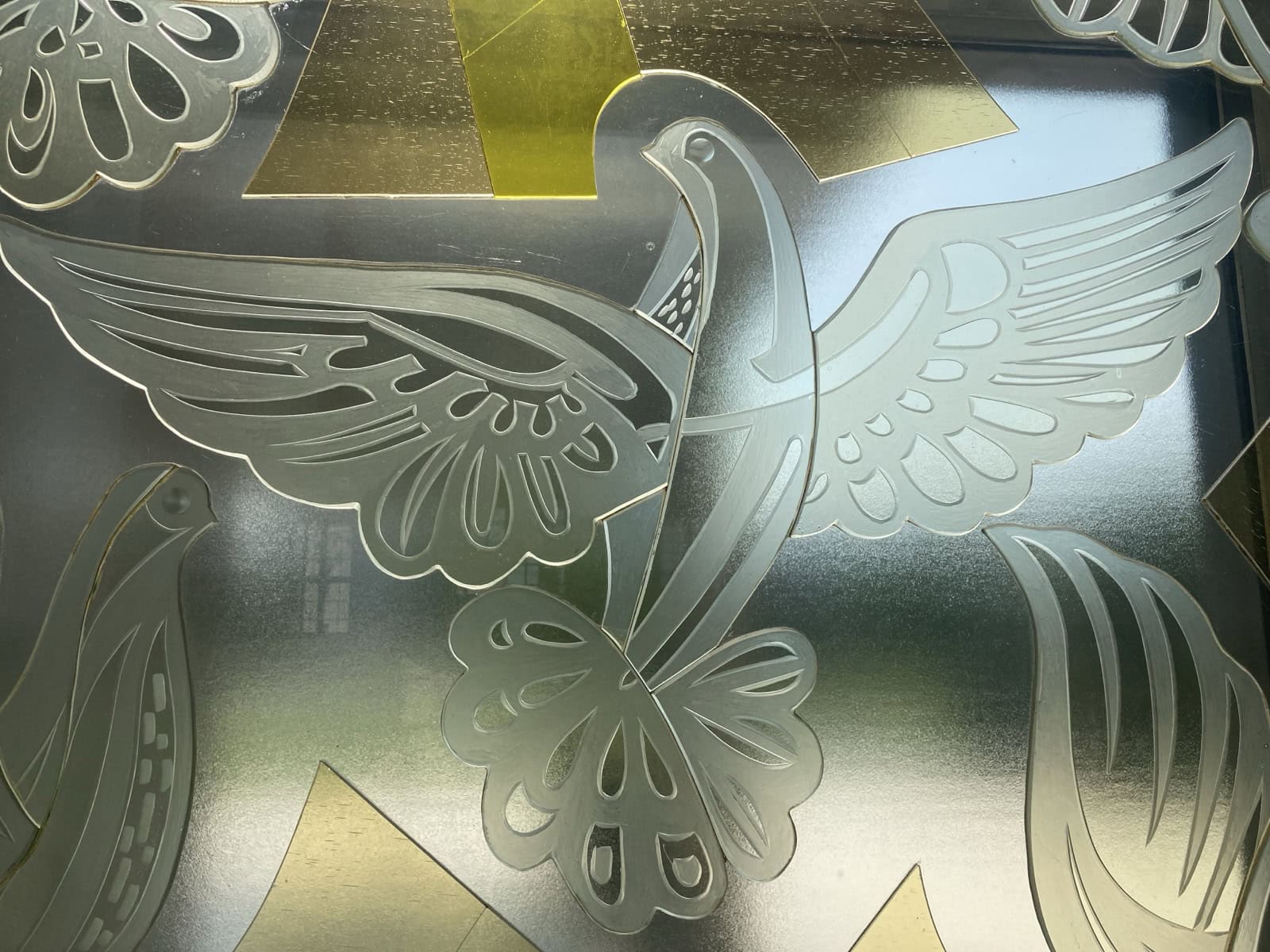
The manufacturing technique is interesting. To avoid giving the impression of church windows, the ornaments were affixed to transparent glass. Unfortunately, I couldn’t find any information about the glass workshop that originally made the window, but I did find a reference to the glass workshop that renovated it in 2012. https://kunstglaserei-berlin.de/restaurierung/womacka-fenster
The tour also takes us to the building’s former ballroom. There, we are surprised by a gigantic wall mosaic featuring the GDR emblem in the center against a simple geometric background of natural stone and glass.
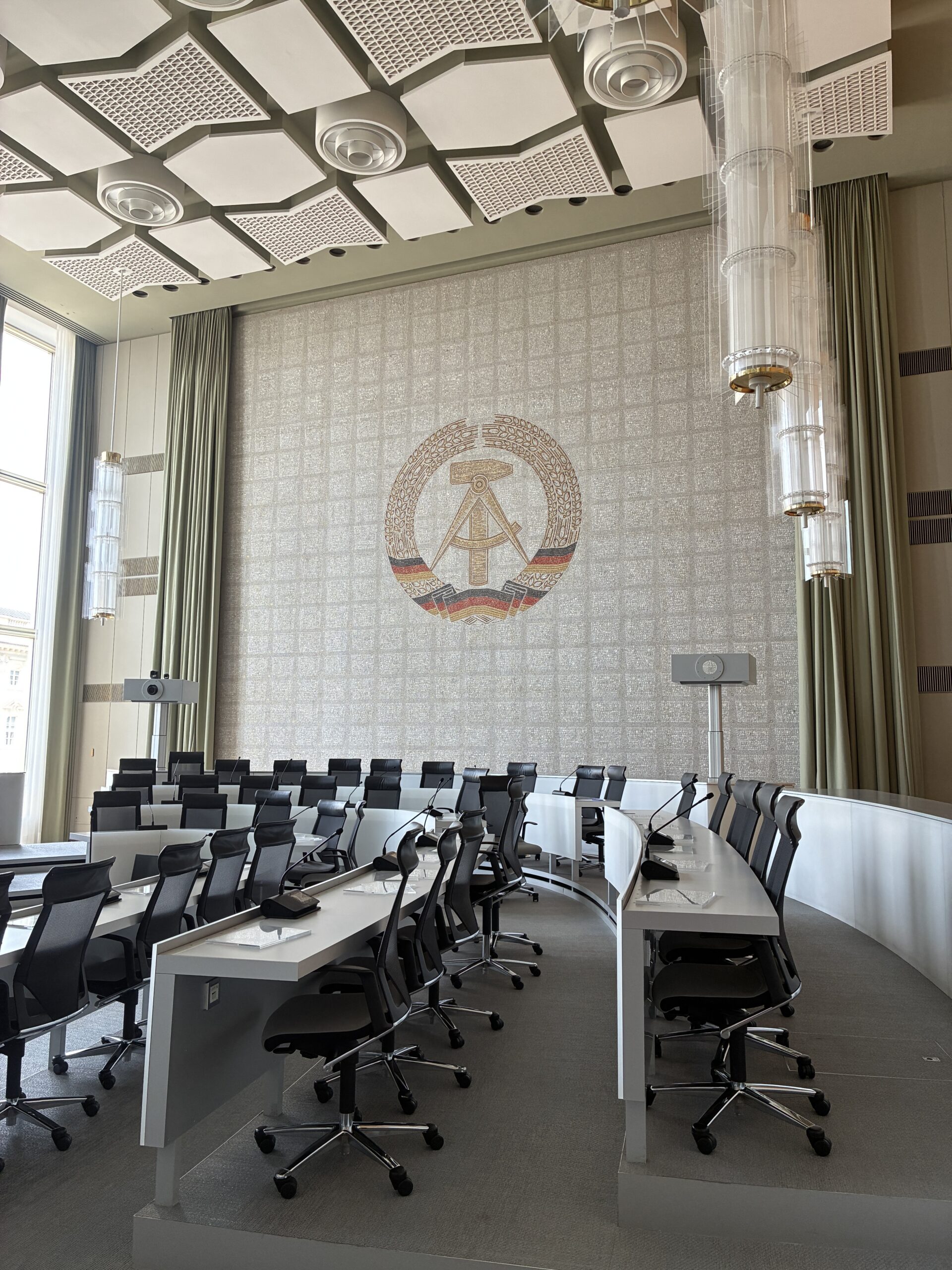
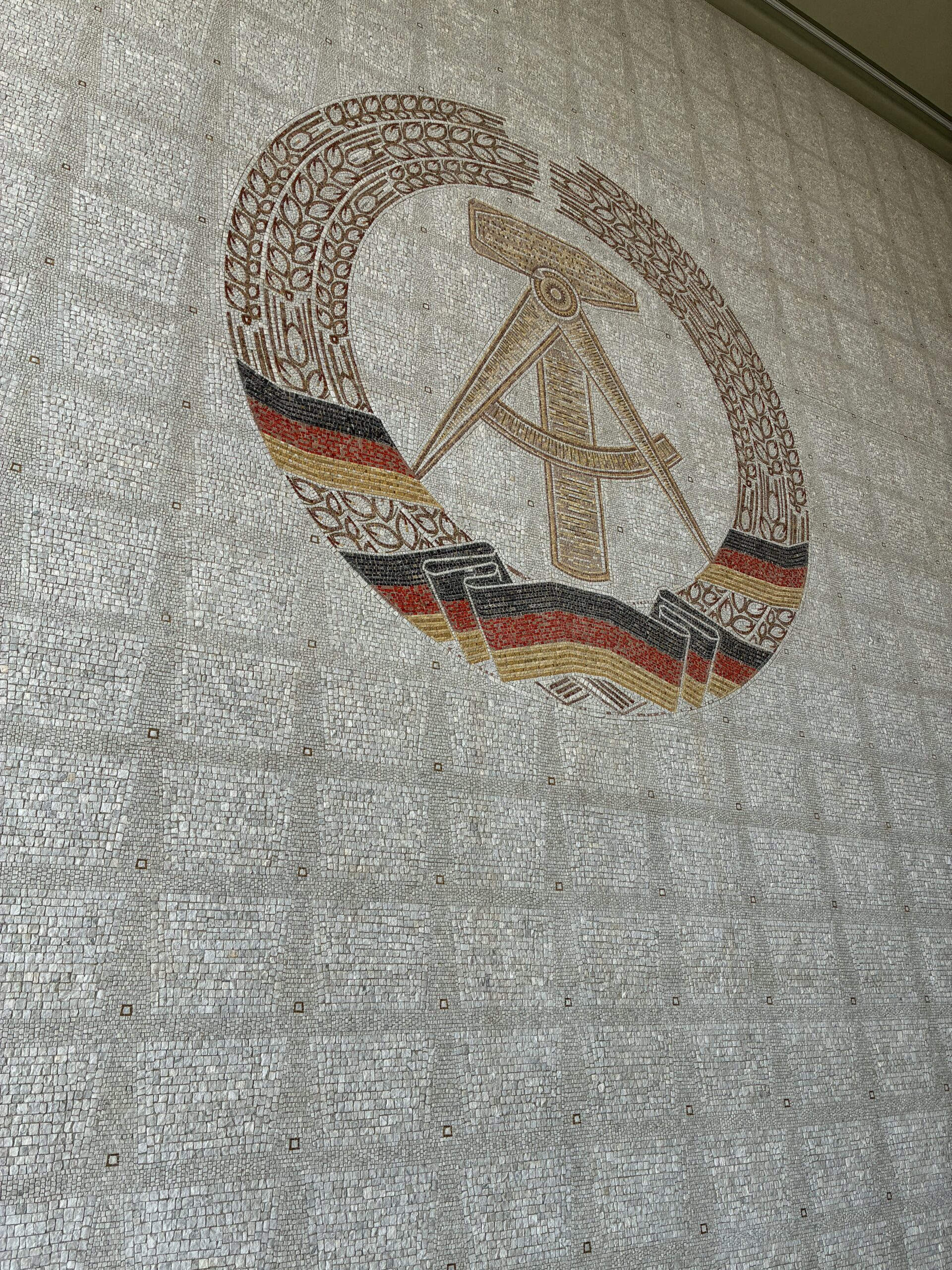
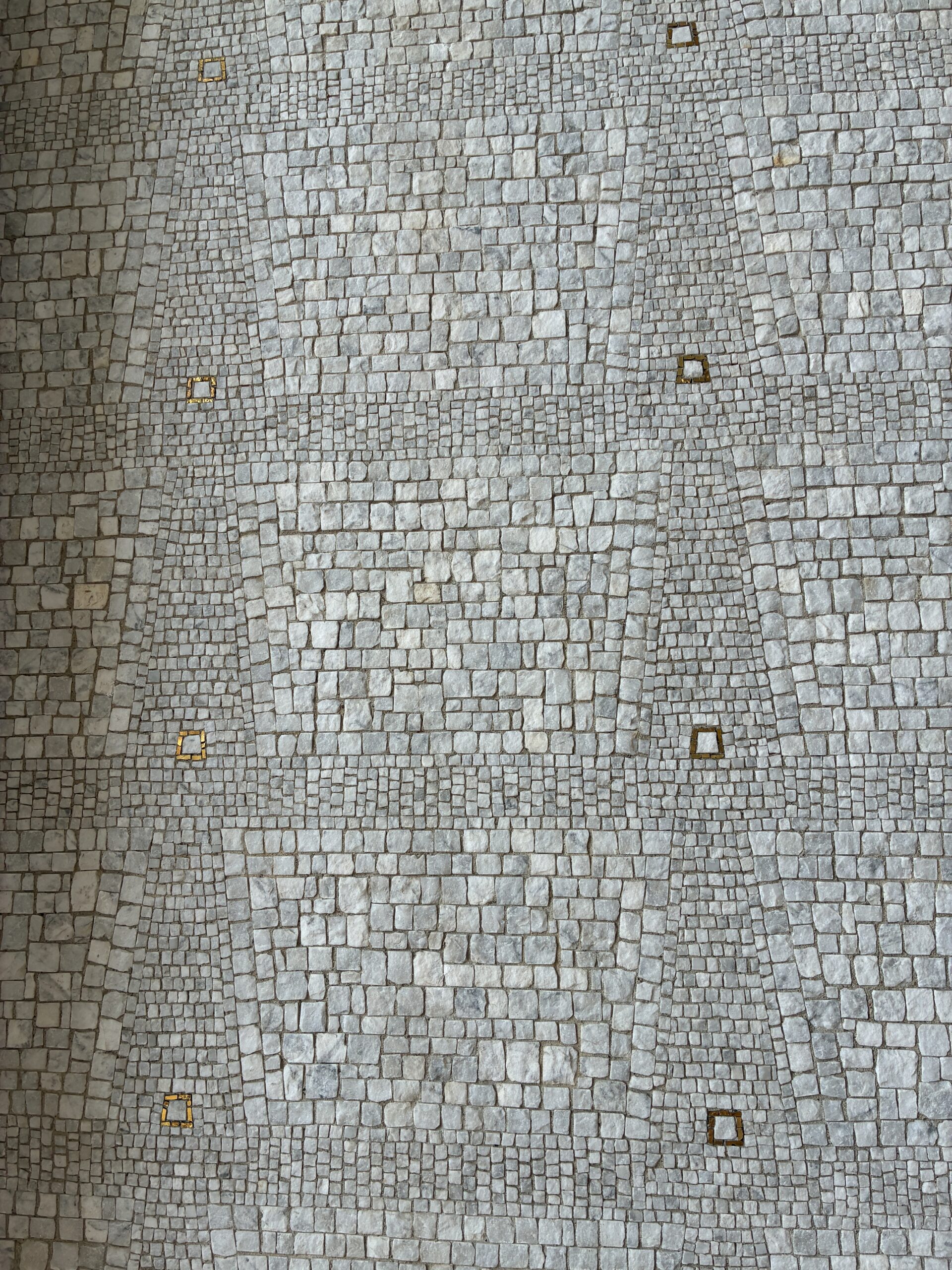
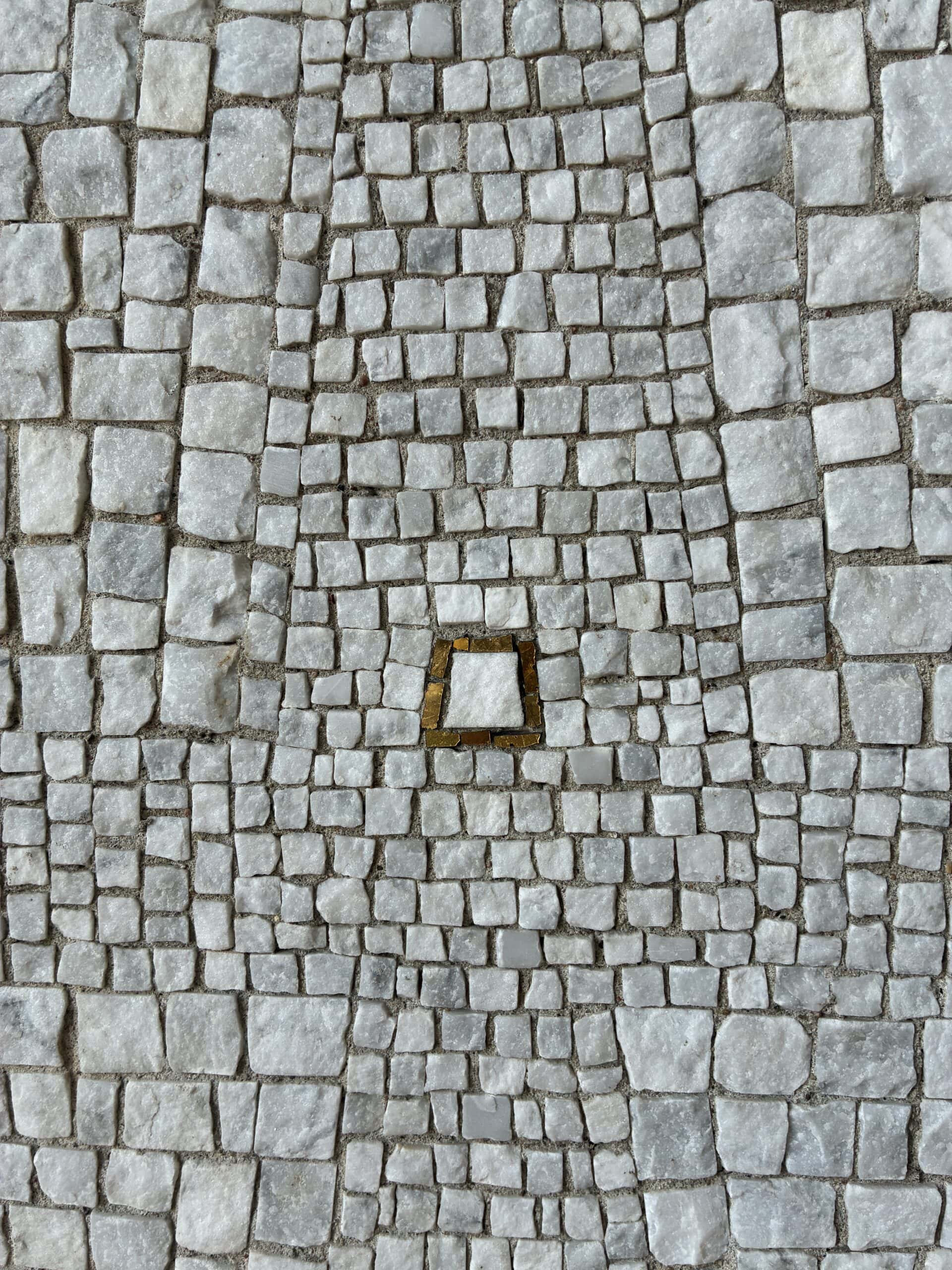
It was designed and created in 1963–64 by Heinrich Jungebloedt (1894–1976), a mosaic artist from the GDR and a student of Puhl & Wagner.
“The 9-by-12-meter mosaic wall, featuring a national coat of arms 3.30 meters in diameter, is the focal point of the hall and is intended to captivate visitors with the brilliance of approximately one million pieces of glass and natural stone.”
Quote from *The Life and Work of Mosaic Artist Heinrich Jungebloedt*, Eichwalde Community History Series, Klaus Schädel, p. 37.
During my research, I got the impression that the mosaic was no longer on display because of its political content. During our visit, however, the curtain was drawn back, and the tour guide said that they no longer had any problems leaving the mosaic uncovered even when the hall was in daily use.
After this unexpected discovery of the mosaic, Sabine and I took the U5 to Weberwiese, where we took photos of the wall mosaics at the James June beer garden.
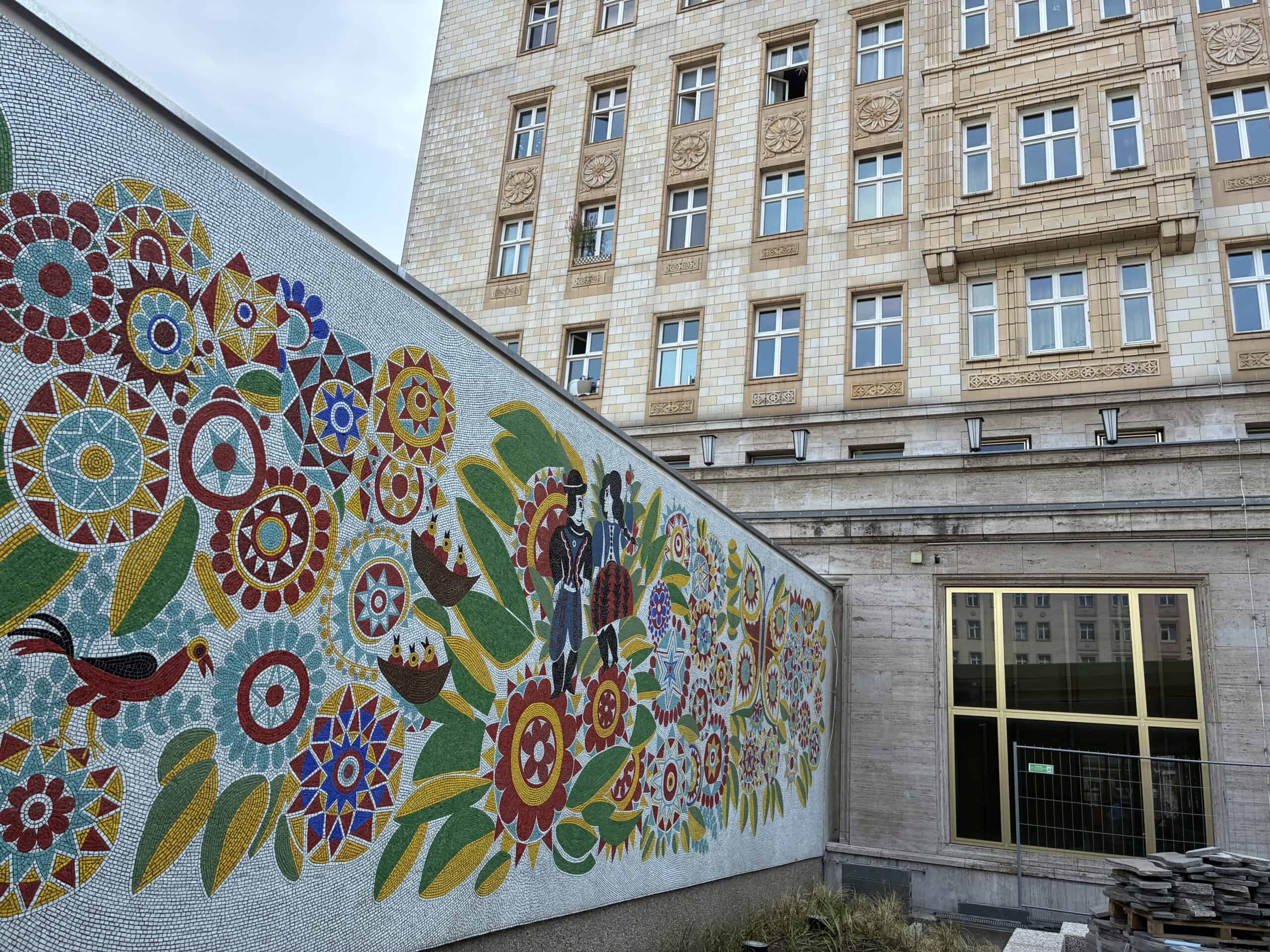
Mosaic at the James June Beer Garden, Karl-Marx-Allee 93, 10243 Berlin
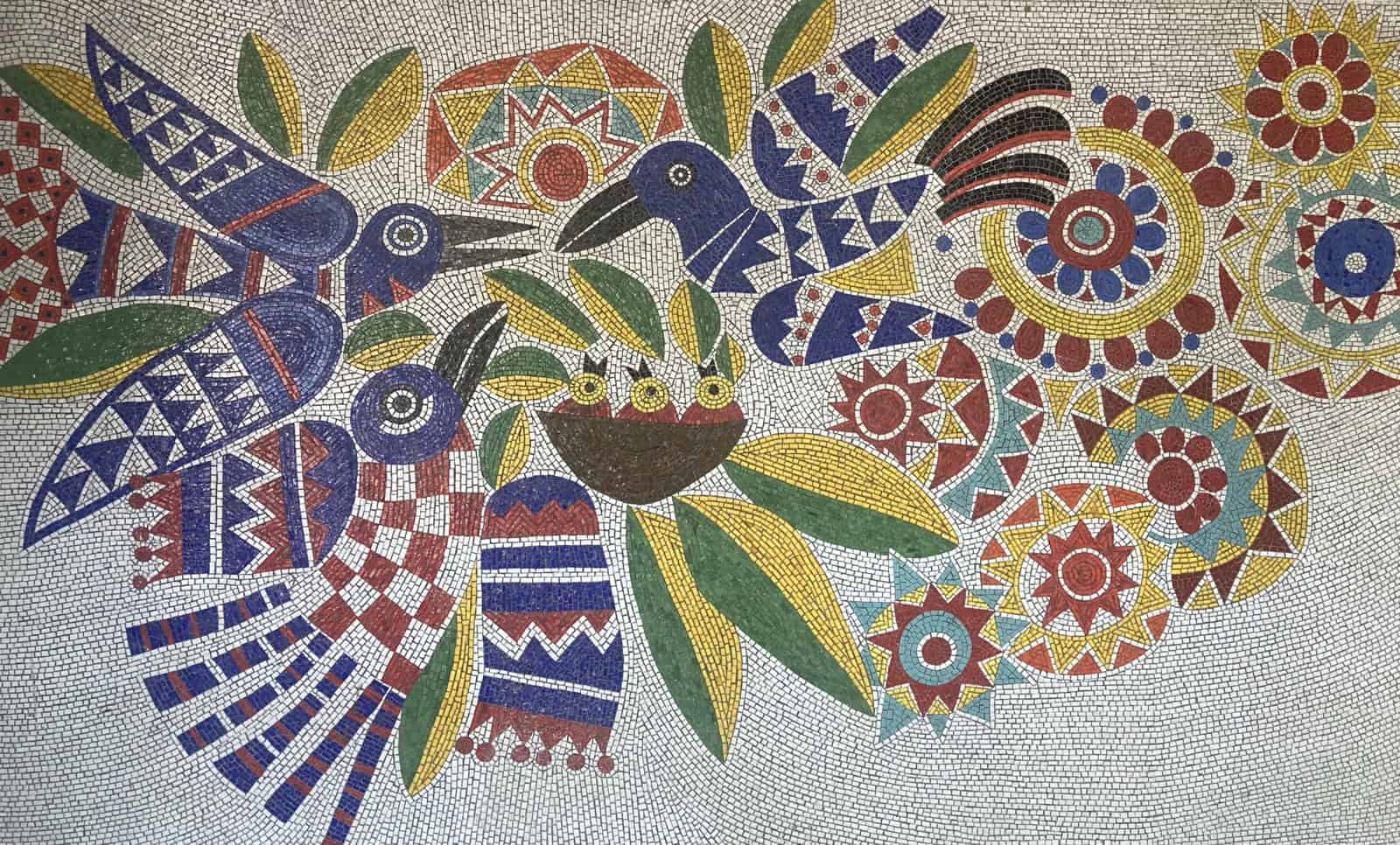
Mosaic Detail, James June Beer Garden, Berlin, Photo by Sabine Ohle
“Architect (Friedericke) Schwalbe promises: ‘The large mosaic will remain permanently visible and accessible to the public.’ The WBM (Berlin Mitte Housing Authority) clarifies that the wall mosaic in the former music pavilion will be accessible up close only via the beer garden, but will be visible from the avenue. The larger wall mosaic extends across the entire rear of the former connecting building and can still be explored via the paved path between the beer garden and the Computer Game Museum,” Tagesspiegel, November 5, 2025, Robert Klages
The cobblestone path Sabine and I went inside to get a closer look at the mosaics. However, to do so, we had to climb onto the construction site (a friendly worker gave us permission to do so) to photograph the mosaics, which had been beautifully restored and made accessible to the public again.
The beer garden is now open, and you can walk up to the mosaics without having to go through a construction site.
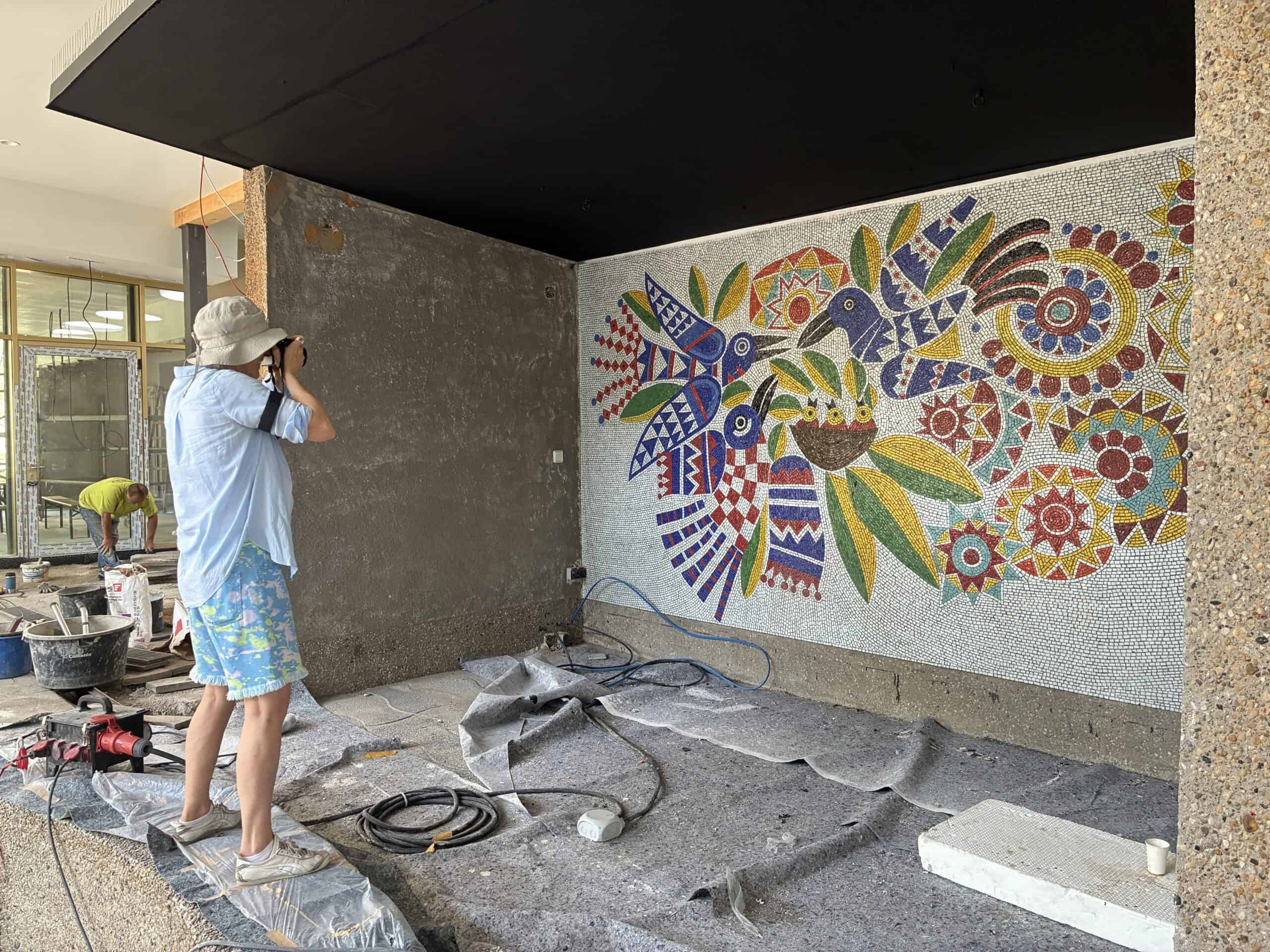
Mosaic at the James June Beer Garden, Sabine at work, Photo: Gertrud Müller
Unfortunately, I haven’t been able to find any information about its creation or the designer yet. Maybe that would be a nice challenge for a mosaic detective.

